Bill
The Amazing Maurice and His Educated RodentsBill, the assistant rat-catcher, is shown first as a worried partner in a criminal business and later as a frightened source of information about its methods. He tries to leave when the operation begins to feel unsafe, but under questioning he reveals how the rat-pit trade depended on breeding captive Rats—and blurts out that he helped make a rat king. His brief appearances connect the scheme’s everyday profit-making to its most disturbing experiment.
Identity and Role
Bill is identified as the assistant rat-catcher, working alongside the more senior Rat-catcher 1. Their conversation makes clear that the business is not limited to catching Rats: the men have stock to move, a continuing supply to maintain, and outside partners who expect deliveries. When Rat-catcher 1 proposes leaving town, Bill points out that Johnny No Hands and his men are due upriver the following night to collect the next load. He also begins to mention that money is owed, showing that the impending departure threatens an active commercial arrangement, not merely an unfinished job.
That exchange gives Bill a practical, transactional presence. He does not offer a plan to confront the danger or repair the enterprise; his attention remains on the next collection and the outstanding payment. Yet he is not the one who insists on staying. Rat-catcher 1 decides that it is time to go, reasoning that people will soon ask questions and that a wise man knows when to quit. Bill’s brief objections register the cost of abandoning the operation, while the senior man’s decision establishes how quickly both men are prepared to cut their losses.
Evasion and Fear
As the pair discuss leaving, Rat-catcher 1 becomes distracted and asks what Bill said. Bill denies having said anything and offers him a cup of tea. The exchange is a small attempt to smooth over a moment of confusion rather than confront it. It does not settle the tension: Rat-catcher 1 questions whether Bill has repeated a phrase about a kitty, and soon a voice from above warns the rat-catchers that running, talking too much, waiting, or trying to be clever will be fatal. Dust falls from the rafters as they look up and see a cat watching them.
Later, when Keith confronts the rat-catchers and invokes an antidote to the poison they fear, Bill falls to his knees and begs for mercy. He appeals to the imagined hardship of a wife and four children left without their father. Malicia immediately points out that he is not married and has no children; Bill retreats to the claim that he might want a family someday. The plea is therefore not a disclosure of his private circumstances but an improvised bid for sympathy. His panic makes him reach for a familiar story of domestic innocence even when the others can disprove it at once.
What Bill Reveals
Under questioning about the Rats taken away from the cages, Bill gives a frantic account of events at the rat pit. He claims that a Rat in a hat descended from the roof and carried one away, then that a larger Rat entered the pit, shouted at the others, bit Jacko, and escaped. The account is delivered in a rush, with Bill’s description of the Rat in a hat flying away lending it the disordered, incredulous quality of a man trying to explain an extraordinary escape while under pressure. Malicia concludes that the Rats are all right; Keith does not let that answer divert him from the rat-catchers’ wider conduct, accusing them of stealing from people and blaming the Rats.
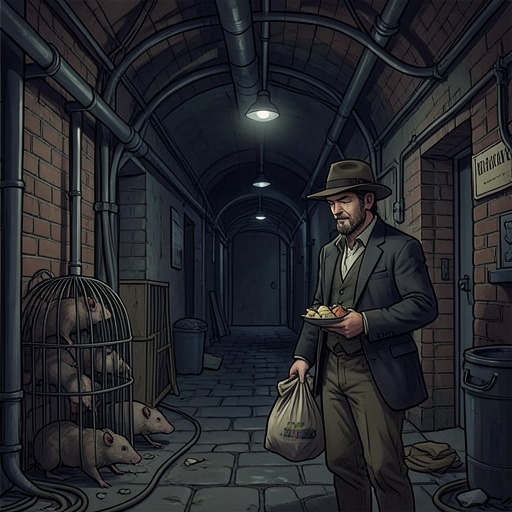
Bill’s more consequential disclosure concerns the supply of animals for the pits. He says rat-catchers have long caught Rats alive for the fights, treating the access to them as a perk of the trade. To keep the supply going, the men bred Rats in captivity. He describes feeding them dead Rats from the pits and repeats the customary justification that Rats eat one another if the green wobbly part is left out. The casualness of that rationale stands beside the brutality it excuses: animals bred as stock are fed the remains of others, while the practice is presented as ordinary and harmless.
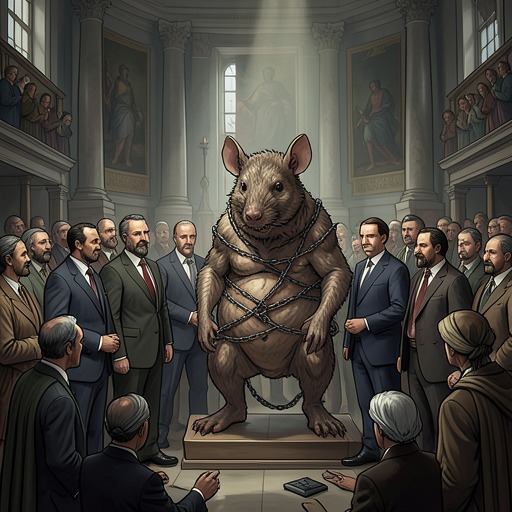
He also explains the next step in the scheme. Ron proposed breeding from the Rats that survived the dogs, on the expectation that their offspring would become larger and better fighters. When the subject turns to a rat king, Bill blurts out the secret and then stammers that he made one, breaking down in tears and telling the questioning voices to stop. The confession links the rat-catchers’ commercial breeding program to the creation of a creature formed through the forced joining of Rats. Bill’s fragmented admission reveals both the scale of the enterprise and his own involvement, although the moment gives no detailed account of his individual part in making it.
Character and Narrative Significance
Bill is drawn through contrast between calculation and collapse. In the shed, he is alert to the next shipment and the money still owed; under threat, he reaches for a false family appeal; during questioning, he can no longer keep the Guild’s secret. These shifts do not amount to a developed account of his life beyond the operation, but they show the changing pressures on a subordinate participant: first the risk of losing a profitable arrangement, then the immediate fear of exposure, and finally the force of knowledge he has helped conceal.
His testimony also makes the rat-catchers’ wrongdoing concrete. The scheme is not simply a matter of taking Rats from the town and selling them for fights. It involves confinement, breeding, feeding captive animals on the dead, and selecting survivors in the hope of producing larger fighters. Bill’s final admission of the rat king brings that sequence to its most extreme point. The story gives him no heroic reversal or established aftermath in these scenes; his narrative importance lies in the disclosures forced out of him, which show how an organized trade in animals can turn from routine exploitation toward deliberate monstrosity.